
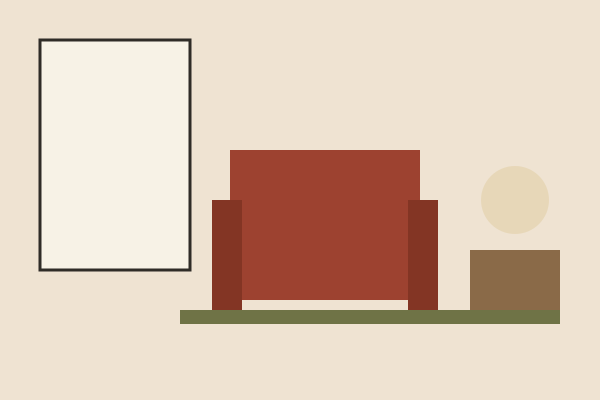
Look around the room you are least happy with and find the one thing in it you would carry to the next house. It might be a chair that has been reupholstered twice, a painting picked up on a trip, a rug inherited from someone, a wooden chest that is not quite the right size for anything. Whatever it is, it is the most useful object in the room, because it is the only one whose place in your life is already settled.
The common way to decorate is the opposite of this. You choose a look, you assemble a set of things that match the look, and then you try to find somewhere for the old piece that does not fit it. The result is a room that reads as a purchase rather than as a place someone lives. It is also a room that dates quickly, because a look has a date attached to it and a possession does not.
Building outward from one piece is a slower method and a more forgiving one. The first decision is not a colour or a style, it is a position. Put the piece where it makes most sense to use it, not where it tidies away most neatly. A reading chair goes where the light falls in the afternoon and where there is room for a lamp behind the shoulder. A table people actually sit at goes where the traffic through the room does not cut across it. Once that position is fixed, a surprising amount of the rest of the room is decided for you.
The second decision is what the piece faces, because that is what everyone sitting in the room will be looking at. In most living rooms the honest answer is a window, a fireplace or another chair, and the room works best when you commit to one of them rather than half-facing all three. A pair of chairs turned toward each other across a small table makes a room for conversation. A single chair turned to the window makes a room for an hour alone. Both are valid; a room that cannot decide is the problem.
Only now does colour come into it, and the piece will usually tell you what to do. Take the piece to the wall and look at the two together in daylight. You are not looking for a match. You are looking for whether the wall is going to sit behind the piece quietly or fight it. A dark green chest against a warm off-white wall recedes into the wall and reads as furniture. The same chest against a cool grey wall stands forward as an object. Neither is wrong, but you should know which one you are choosing.
The third thing the piece decides is scale. If your starting object is generous, the things around it have to be generous too or they will look like accessories. A deep armchair beside a spindly side table makes the table look like an afterthought. A low solid chest beside the same chair makes both look deliberate. Measure the piece, write the two numbers down, and carry them with you. Almost every scale mistake in a room is somebody guessing from memory in a shop.
What is left after all this is the layer that people usually buy first and should buy last: the small tables, the lamps, the cushions, the rug. These are the pieces that tune a room, and they are much easier to choose once the room already has a shape. A rug bought to define a seating area you have already lived with for a month is a different purchase from a rug bought to create a seating area you are imagining.
Give the arrangement a weekend before you commit to anything. Sit in it in the morning and in the evening. Notice where you put a cup down and whether there is anything there. Notice whether you turn a lamp on earlier than you expected, which usually means the daylight is not reaching the chair and the chair is in the wrong place. Rooms tell you these things quickly if you let them, and moving a chair costs nothing, which is more than can be said for the alternative.
The method has one more advantage, which is that it survives moving house. A room assembled as a look has to be rebuilt from scratch somewhere else. A room built outward from a piece you love travels with the piece, because the method travels with it. You find the light, you find the position, and you start again from the same place.