
Bedrooms are the rooms people most often describe as wanting to feel calm, and the rooms in which calm is most often pursued by removing everything. The result is a flat, slightly hard space that photographs well and is not especially restful to be in. What makes a bedroom feel settled is not emptiness; it is texture doing the work that pattern and colour do elsewhere.
The practical version of this is to count textures rather than colours. A room with linen, wool, a woven rug, unfinished wood and a paper lampshade has five distinct surfaces in it, all of which can be the same quiet colour and none of which reads as busy. A room with five colours in the same smooth cotton has one texture and reads as noisy. The first room is the one people call calm.
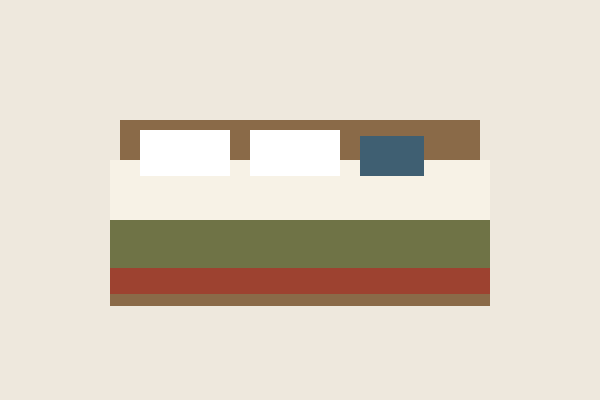
On the bed itself, work in layers with a clear order and let each layer be a different weight. A sheet, then something thin and flat like a blanket, then something with loft like a quilt or a duvet under a cover, then one folded piece across the foot. Four layers is plenty. The folded piece at the foot is doing more than it looks: it breaks the large flat plane of the bed into two proportions and gives the eye somewhere to stop.
Pillows are where restraint pays. Two sleeping pillows, two that match the bed linen and one or two that do not, is enough for almost any bed. Beyond that you are building a pile that has to be moved every night, and anything that has to be moved every night will eventually live on the floor. Vary the sizes rather than multiplying the count: a square cushion in front of rectangular pillows does more than a third rectangle.
Pattern should be rationed. Let one thing carry pattern and keep everything else plain, and put the patterned thing where it will be seen from the door, because that is the view the room is judged on. If the rug is the patterned element, the bed stays quiet. If the bed is patterned, the rug should be a texture rather than a design. Two patterns can be made to work when one is much larger in scale than the other, but it is a harder job than it looks and there is no prize for attempting it.
Curtains are the layer most often underweighted. A thin curtain hung close to the frame makes a window look smaller and lets in a lot more light than most people want at six in the morning. Hung wide and high, so the fabric stacks against the wall rather than across the glass, the same window looks larger and the room gains a soft vertical surface on what was a hard one. Weight and fullness matter more than fabric choice here.
Judge everything in the light you will actually use. A bedroom is mostly seen early and late, in low warm light, and materials behave very differently then. Cool greys that look crisp at midday can go slightly blue and unfriendly under a warm lamp. Warm off-whites that look creamy at midday settle down beautifully. Take the samples into the room in the evening with the lamp on and look at them against the wall, on the bed and on the floor, because fabric on a horizontal surface reads several shades darker than the same fabric held up vertically.
None of this requires replacing what you have. Most bedrooms that need help need one more texture and one less pattern, which is usually a blanket added and a set of cushions retired.